
Workers First Sets the Standard for Ethical AI in Workforce Development
The AFL-CIO’s landmark initiative positions ethical AI as a workforce strategy and a new benchmark for organizational leadership.
On October 15, 2025, the American Federation of Labor and Congress of Industrial Organizations (AFL-CIO) launched the Workers First Initiative on AI. It is the first comprehensive labor agenda focused on artificial intelligence. Representing 63 unions and nearly 15 million workers, the nation’s largest labor federation released a detailed framework for integrating AI into the American workplace.
This move signals a shift toward clear, measurable standards that prioritize long-term capability, worker trust, and responsible innovation.
The Significance of the Workers First Initiative
The Workers First Initiative responds to urgent challenges facing today’s workforce. As AI adoption accelerates, concerns about its impact on employees and labor rights have prompted calls for stronger protections and clearer ethical standards.
Recent data highlight the scope of this shift:
- All 50 states have introduced AI regulations.
- Around 40 states have already passed AI legislation.
- 80% of Americans across party lines support strong government rules for AI safety.
This momentum reflects a broad consensus. While major technology companies continue to promote rapid AI deployment without consistent safeguards, the AFL-CIO is drawing boundaries that protect workers and support responsible innovation.

As AFL-CIO President Liz Shuler stated:
“We reject the false choice between American competitiveness on the world stage and respecting workers’ rights and dignity. We know that for AI—or any other technology—to truly boost our economy, it needs to benefit everyone, not just a select few at the top.”
This framework moves beyond the debate between innovation and protection. It offers a model for innovation through partnership. One that forward-thinking organizations can act on today.
Inside the Workers First Initiative
The Workers First Initiative introduces five foundational principles for ethical AI adoption. These principles offer a practical framework for aligning technology with workforce development:
Worker voice in system design
Employees should help shape the AI tools they use, ensuring systems reflect real workflows, challenges, and needs.
Collective bargaining and consultation
AI adoption should be treated as a workplace change, with formal negotiation or structured worker input to guide implementation.
Transparency in publicly funded systems
When public funds support AI, agencies must disclose how systems operate, what data they use, and how decisions can be reviewed or challenged.
Safeguards against surveillance overreach
Organizations must set clear boundaries around AI-powered monitoring to protect privacy, autonomy, and workplace trust.
Retraining and transition support
When AI changes job roles or tasks, employers should invest in skill-building, mobility pathways, and long-term career development.
These principles are designed to be applied across sectors and organizational types. They set the foundation for responsible AI strategies that prioritize human impact, operational integrity, and long-term resilience.
The State-Level Reality Shaping Compliance
While federal AI policy remains stalled, states are advancing quickly. The AFL-CIO’s AI Task Force, launched earlier this year, is driving protections at state and local levels through targeted legislation and coordinated advocacy.
In California, Senate Bill 7, known as the No Robo Bosses Act, would have required human oversight of AI-enabled firings and workplace discipline. Though it passed the Legislature, Governor Newsom vetoed the bill, citing concerns about scope and enforcement. Still, similar proposals are emerging across other states and at the federal level.
As Chrissy Lynch, president of the Massachusetts AFL-CIO and co-chair of the AFL-CIO State Federation AI Task Force, framed the stakes clearly:
“Our country has a choice: a future where AI makes work easier, safer, and more productive, or a future where workers are subjected to brutal production quotas set by algorithms, where robots threaten their careers, and where their data is violated by digital overlords.”
For organizations operating across multiple states, this creates a complex and evolving regulatory landscape. The strategic response is to adopt internal standards now that anticipate regulation, rather than scramble to meet it later.
What This Means for Government Agencies
Public sector organizations carry distinct responsibilities in advancing ethical AI for workforce development. As stewards of public trust, government agencies deploy AI systems that directly shape access to benefits, services, and legal protections.
The Workers First Initiative affirms the principles essential to effective implementation: transparency, employee involvement, and democratic accountability. These values support mission integrity and reinforce public confidence.
Government agencies also hold significant influence. As purchasers of publicly funded AI systems, they can set clear expectations for vendors. These expectations may include:
- System transparency and explainability
- Worker consultation during development
- Commitment to labor protections and fair employment practices
- Accountability mechanisms for addressing system failures or biased outcomes
Procurement standards like these can shift the broader AI marketplace toward more responsible development. When the government leads with high expectations, the industry follows.
What This Means for Nonprofits
Nonprofit organizations often approach AI adoption with caution. Limited budgets, lean staffing, and mission-driven cultures can make technology investment feel disconnected from direct service.
The Workers First Initiative offers a clear path forward. Responsible AI adoption can strengthen mission delivery by freeing staff to focus on relationship-building, creative problem-solving, advocacy, and direct service.
This is especially relevant in workflows like intake documentation, benefits screening, appointment scheduling, and donor communications. When staff are involved in design and rollout, these tools reduce administrative burden and improve service quality.
Organizations that embrace worker-centered AI often lead with innovation. Mission focus keeps technology grounded in human impact. Collaborative cultures make staff involvement intuitive. Resource constraints drive practical, high-value solutions.
What This Means for Corporations
Private sector leaders are increasingly evaluating how AI adoption affects competitiveness. Involving workers in implementation is proving to be a high-impact strategy. Organizations that take this approach report faster adoption, more effective use of tools, and solutions that align with operational needs.
This success is driven by frontline insight. Employees surface issues early, identify practical use cases, and contribute to smarter deployment. Their involvement builds trust and strengthens long-term outcomes.
The broader landscape is shifting as well. In California, the AFL-CIO increased political spending from $70,000 in 2023 to over $2 million in 2024, focused on advancing worker-centered AI policies. At the same time, major tech firms have launched lobbying efforts and formed AI super PACs to influence regulation.
In this environment, companies that lead with ethical AI practices build reputational and operational advantages. These practices support recruitment and retention, especially as workers weigh technology policies when choosing employers. Organizations that use AI to support employee capabilities also preserve institutional knowledge and maintain strategic value.
As Ed Wytkind, interim director of the AFL-CIO Technology Institute, explains, worker involvement helps companies “save money by avoiding purchasing useless or unsafe technology.” This is a business strategy grounded in operational insight and aligned with workforce priorities.
How to Implement Workers First Principles Today
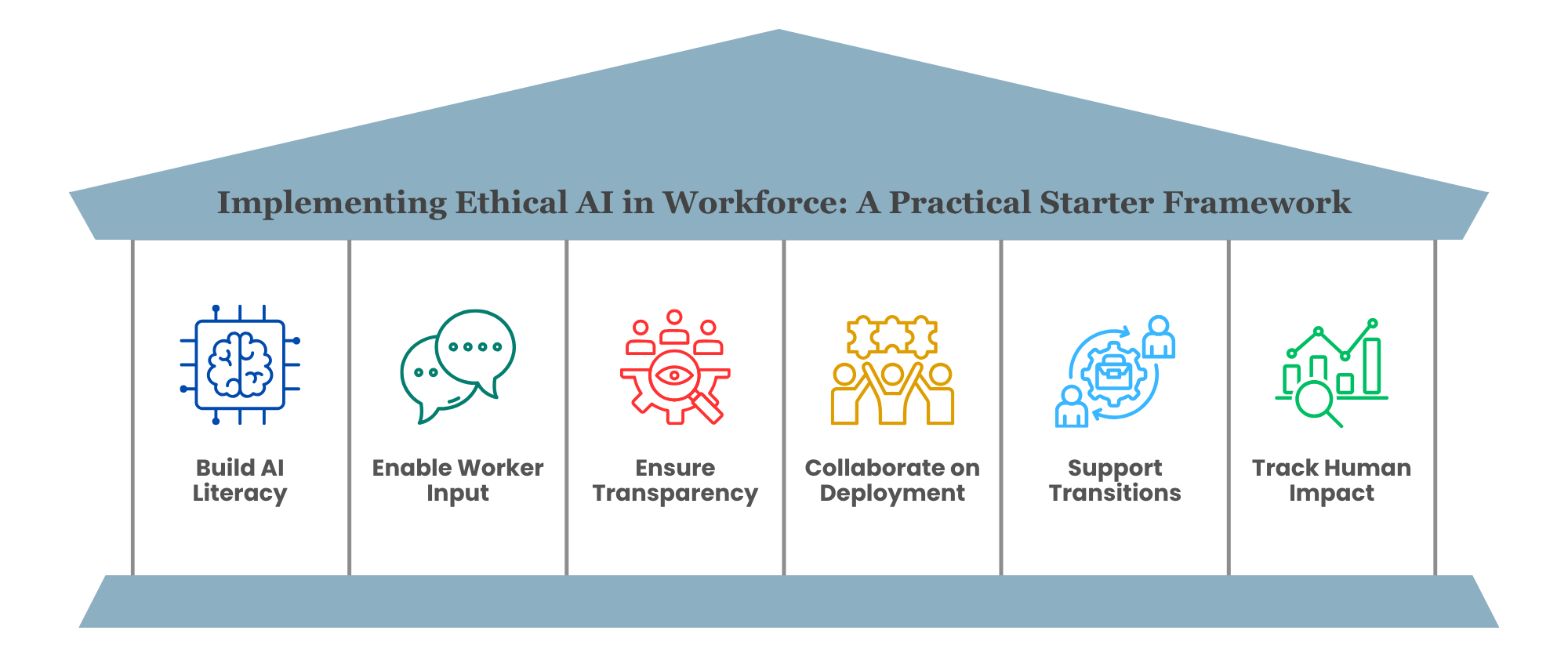
You don’t need perfect systems or enterprise-wide transformation to begin. One well-designed process built on Workers First principles can set the foundation. Here’s a practical framework for getting started.
Build AI Literacy First
Before deploying any AI system, invest in education across your organization. Workers should understand AI capabilities, limitations, and how these systems may affect their roles. Informed teams ask better questions, identify issues early, and use tools more effectively.
Create Genuine Input Mechanisms
Establish formal channels for worker feedback before, during, and after implementation. This might include labor-management committees, cross-functional working groups, or regular feedback sessions. The key is to ensure these mechanisms are meaningful and shape real decisions.
Build Transparency into Systems
Document and communicate clearly:
- How AI systems make decisions
- What data they use and how it’s protected
- What human oversight is in place
- How workers can raise concerns or challenge outcomes
Transparency strengthens confidence and accelerates adoption.
Make Implementation Collaborative
Approach AI deployment as a shared process. Whether through formal bargaining or informal consultation, address:
- How technology will change work
- What training will be provided
- How performance metrics may evolve
- How concerns will be heard and resolved
Collaboration builds shared ownership and reduces resistance.
Invest in Transition Support
When AI changes tasks or roles, provide clear pathways forward. Offer retraining programs, internal mobility options, tuition assistance, or apprenticeships that build new capabilities.
Measure Human Impact Alongside Productivity
Track operational efficiency, and monitor job satisfaction, skill development, workload balance, and retention. Ethical AI adoption improves work quality while sustaining effectiveness.

Lead the Future of Work Responsibly
The Workers First Initiative sets a clear benchmark for ethical AI adoption. It provides a framework for aligning technology with workforce insight, strengthening operational resilience, and supporting employee development.
Organizations that apply these principles build trust, improve implementation outcomes, and create workplaces where innovation supports human capability. These strategies reinforce recruitment, retention, and long-term performance.
Whether you’re advancing public service, nonprofit missions, or corporate innovation, the path forward is clear: build AI strategies that elevate both your organization and your workforce.
Lead the Future of Work Responsibly
The Workers First Initiative sets a clear benchmark for ethical AI adoption. It provides a framework for aligning technology with workforce insight, strengthening operational resilience, and supporting employee development.
Organizations that apply these principles build trust, improve implementation outcomes, and create workplaces where innovation supports human capability. These strategies reinforce recruitment, retention, and long-term performance.
Whether you’re advancing public service, nonprofit missions, or corporate innovation, the path forward is clear: build AI strategies that elevate both your organization and your workforce.
Partner with Experts in Ethical AI Adoption
Looking for expert guidance on ethical AI for workforce development? AI InnoVision provides consulting, training, and strategic support to help government agencies, nonprofits, and corporations navigate AI adoption responsibly.
From executive leadership training to hands-on workforce development programs, we build AI strategies that strengthen both organizational capability and employee engagement.
Contact us today to learn how we can help your organization turn responsible AI adoption into a competitive advantage.